Reconsidering “Back There”
by Michael DeSapio
Michael DeSapio is a writer and classical musician from the Washington, D.C. area. Raised on vintage television, he developed a love for The Twilight Zone during his college years and enjoys deepening his appreciation for this timeless series through analyzing its themes and symbolism. He has written compelling essays on the episodes, with a special emphasis on those that are lesser known or underappreciated. Please read them for a fascinating new spin on the episodes.
To contact Michael, send email to: michaelmartind@gmail.com
 “Witness a theoretical argument, Washington, D.C., the present. Four intelligent men talking about an improbable thing like going back in time. A friendly debate revolving around a simple issue: could a human being change what has happened before? Interesting and theoretical, because who ever heard of a man going back in time? Before tonight, that is, because this is – “The Twilight Zone.””
Time travel was one of The Twilight Zone’s most engrossing themes. Whether characters were suddenly jolted into the past, or were catapulted from the past to the present and dealt with the consequences of modern life, the fish-out-of-water results were fascinating and entertaining. The second season of The Twilight Zone featured two very different stories by Rod Serling involving time travel between the nineteenth century and the twentieth. Of the two episodes, “Back There” is considerably less well regarded than “A Hundred Yards Over the Rim”, which in writing, acting and cinematography approaches Twilight Zone perfection. Nevertheless, “Back There” is a handsomely made and thought-provoking episode, one that invites us to ponder how our lives are effected by the “little” events in history.
The episode opens in an exclusive men’s club, the Potomac Club, in Washington D.C.; the date is April 14, 1961. Peter Corrigan, a young engineer, is engaging his colleagues in a speculative discussion about the possibility of time travel. (As ever in the Twilight Zone, the characters’ names give us a clue to their nature: “Corrigan” sounds like “correction”, the correction of the past which Corrigan will attempt to make.) On his way out of the club, Corrigan bumps into a butler named William and notices a bust of Abraham Lincoln on a table. While standing on the landing outside the club, a haze comes over him; suddenly he realizes he is wearing archaic dress. The street, too, has been transformed: electric street lamps have been replaced by gas lamps, and automobiles have given way to horse-drawn carriages. As Corrigan soon discovers, he is in the same Washington, D.C. street–but on April 14, 1865, the day President Lincoln was shot. (“Back There” takes on added irony and poignancy when we consider that less than three years after its original airing, another president–John F. Kennedy–would be assassinated.)
There seems at first glance to be no inner necessity for Corrigan’s spontaneous voyage back in time. Yet on closer examination, Corrigan’s time travel seems directly to result from his conversation with his fellow club members. It’s as if the Twilight Zone responded to Corrigan’s need for an answer to the question of time travel; combining, in the manner of a dream, the time travel conversation with the Lincoln bust, it thrusts Corrigan back in time immediately to Lincoln’s Washington. The powers-that-be in The Twilight Zone want Corrigan to learn a lesson about time and human nature–and a sober lesson at that.
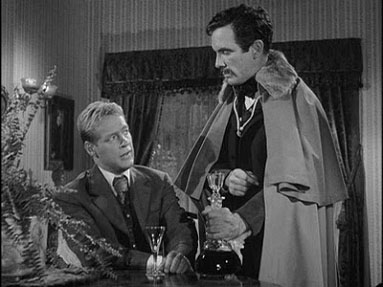
As Corrigan discovers, the main events of history–such as Lincoln’s assassination–cannot be changed. Corrigan’s warnings about the assassination are taken as the ravings of a lunatic, and he is taken into police custody. John Wilkes Booth himself comes round to muzzle Corrigan’s efforts, drugging him and locking him in a room. Lincoln is shot on schedule; Corrigan’s aspirations to change history have apparently been thwarted. But when Corrigan is returned to 1961 and his club, he comes to a startling realization: William, the butler whom he bumped into in the first scene, reappears as one of the rich club members at the head of the table. As it turns out, the one person in 1865 who believed Corrigan’s story–a patrolman at the police station–became famous as a result of his clairvoyance, got very rich, and left his wealth to his descendents. His great-grandson is none other than William. So by altering a small, local and personal detail of the past, Corrigan has altered a small, local and personal detail in the present. Events in the past are like a stone falling in a lake, causing many ripples. Or as Serling, using another metaphor, tells us in his closing narration, “the skein of history cannot be undone, yet small fragments of tapestry can be altered.”
 If “Back There” were meant only as an entertaining speculation about Lincoln, then it would have to be counted a dramatic failure. After all, it’s a foregone conclusion that the Lincoln assassination can’t be undone; and anyway, this supposedly central event happens off screen. But Lincoln’s assassination is only the backdrop to “Back There.” The episode is really a social commentary on the eternal clash between individual and society. Peter Corrigan is one of a long line of Serling outsiders. Like Millicent Barnes in “Mirror Image”, Nan Adams in “The Hitch-Hiker”, Arthur Curtis in “A World of Difference” and countless others, Peter Corrigan sees something–knows something–that he cannot seem to convey to those around them. (Corrigan’s outsider status is emphasized by the fact that his fellow club members all appear to be decades older than him.) One man alone (the patrolman) gives Corrigan the vote of confidence. He believes Corrigan’s story–and is subsequently rewarded with glory he never would have had otherwise.
 If “Back There” were meant only as an entertaining speculation about Lincoln, then it would have to be counted a dramatic failure. After all, it’s a foregone conclusion that the Lincoln assassination can’t be undone; and anyway, this supposedly central event happens off screen. But Lincoln’s assassination is only the backdrop to “Back There.” The episode is really a social commentary on the eternal clash between individual and society. Peter Corrigan is one of a long line of Serling outsiders. Like Millicent Barnes in “Mirror Image”, Nan Adams in “The Hitch-Hiker”, Arthur Curtis in “A World of Difference” and countless others, Peter Corrigan sees something–knows something–that he cannot seem to convey to those around them. (Corrigan’s outsider status is emphasized by the fact that his fellow club members all appear to be decades older than him.) One man alone (the patrolman) gives Corrigan the vote of confidence. He believes Corrigan’s story–and is subsequently rewarded with glory he never would have had otherwise.
Meanwhile, William’s change of fortune illustrates how present-day wealth and glory are often the result of mere accidents of history, and how chance occurrences can affect future generations. Not only William’s station but his personality has changed: at the beginning a meek and diffident butler, he transforms at the end into a snobbish, smug millionaire. This can be read as a metaphor for social climbers of all eras: with elevation in social standing often comes a degradation of character. Indeed, something of the entire moral atmosphere has changed upon Corrigan’s return. Now the club members are not having a stimulating philosophical discussion about time travel; instead they sit discussing “money, and the best ways to acquire it”, the “palaver of self-made swindlers.” Corrigan comes to the realization that:
“In the matter of time travel, gentlemen, some things can be changed, others can’t.”
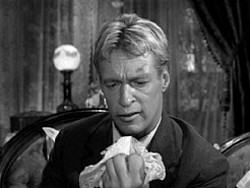
 In other words, human nature is ever the same. In both 1865 and 1961, Corrigan is ignored and scoffed at; in both 1865 and 1961, complacent and corrupt men rule the world. Corrigan is deeply shaken by his experience; he is still clutching the handkerchief bearing the initials JWB which John Wilkes Booth gave him–proof that his time-traveling experience really happened. The club members whisper jadedly among themselves: “Looks piqued, doesn’t he?”; “Acting so strangely!”; “What’s the matter with him?” They will never know what Corrigan has gone through, nor understand the changes he effected.
“Back There” delivers a bitter message about the immutability of human nature. Jerry Goldsmith’s tense, expressionistic musical accompaniment (the score features an obbligato harpsichord to suggest the past) contributes in no small part to the episode’s acerbic mood. Russell Johnson’s performance as Peter Corrigan has been accused of being hammy; yet this theatricality fits the Victorian setting and lends his character a futile mock-heroic quality which is appropriate. In the mise-en-scene, the transformation from 1961 to 1865 is handled with elegance and grace: a mere shot of an electric street light changing into a gas lamp tells us all we need to know. Serling’s script plays on the historical clash in clever ways: for example, when a landlady asks Corrigan whether he is an army veteran (meaning of the Civil War), Corrigan (who is likely a World War II veteran) answers, “Yes, as a matter of fact, I am.” Later, Booth tells Corrigan that he dabbled in medicine of the mind, and professes never to have heard of the modern term “psychiatrist.” Details like this show the care and historical awareness with which Serling approached his assignment.